
Yes, Jesus Was a Refugee

Don’t let the opponents of immigration rewrite the Christmas story.
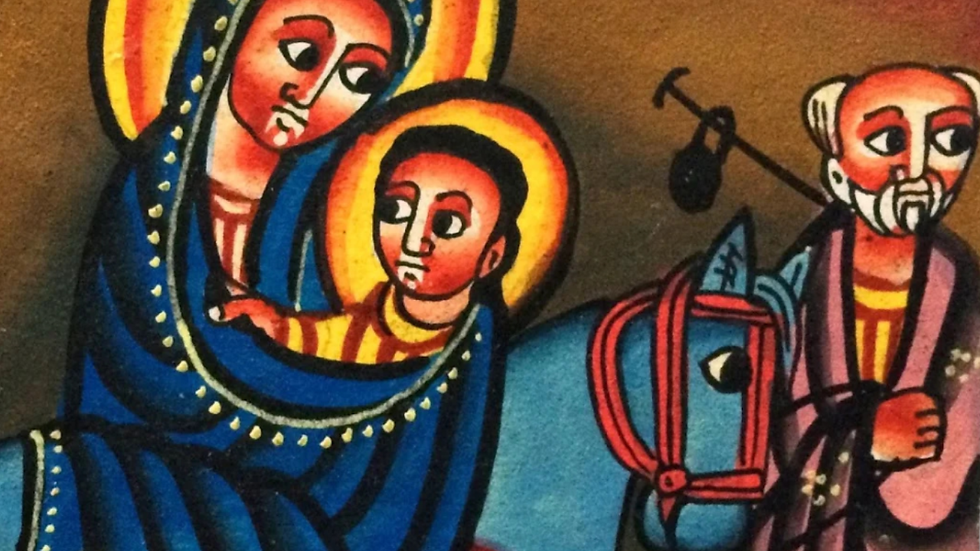
Every Christmas, we recount the story of Jesus, Mary, and Joseph fleeing from Judea to Egypt to escape the wicked King Herod. Clergy and theologians frequently link the Holy Family to other distressed people on the run, and have been doing so long before our modern fight over immigration. In 1952, Pope Pius XII said,
“The Holy Family of Nazareth, fleeing into Egypt, is the archetype of every refugee family. Jesus, Mary and Joseph, living in exile in Egypt to escape the fury of an evil king, are, for all times and all places, the models and protectors of every migrant, alien and refugee of whatever kind who, whether compelled by fear of persecution or by want, is forced to leave his native land, his beloved parents and relatives, his close friends, and to seek a foreign soil.”
Not everyone agrees with this analogy. Some critics accuse us of using a central element of the Christian story for political ends when we should be focusing on singing our hymns and saying our prayers instead. Others point out that both Judea and Egypt were part of the Roman Empire, so the Holy Family doesn’t qualify for refugee status. Instead, they were like people fleeing from Alabama to Vermont, remaining within the same political entity throughout their lives.
If we want to be pedantic, we can grant that the Holy Family might not technically qualify as refugees. In modern parlance, we might call them “internally displaced peoples.” Nonetheless, historical and geographical realities of the time confirm that Pope Pius was correct in linking the Holy Family's situation to that of modern refugees.
Rome considered Judea and Egypt to be part of the same empire, but we have no reason to think that faithful Jews in the first century saw it that way. Judea was notoriously difficult for Rome to rule because many Jewish people believed that God had promised the land to them. The Maccabean Revolt, the uprising of AD 66–70, and the Bar Kokhba rebellion testify to this. For the Holy Family, leaving Judea for Egypt surely meant leaving home – a particular land God had promised to their ancestors.
In addition, Mary and Joseph didn’t flee Roman authorities in general; they fled a specific local ruler, Herod. His power extended only within Judea, which meant Joseph and Mary were most at risk while they remained in his territory. By fleeing to Egypt, they placed themselves outside Herod’s jurisdiction and significantly reduced the danger they faced, even while remaining within the broader Roman Empire.
There were also cultural differences between Egypt and Judea. Across the Roman Empire, elites spoke Greek and Latin, while the language of common folks varied from place to place. A move from Judea to Egypt would have taken the Holy Family from an Aramaic-speaking society into one where Coptic ruled the day. There were Jewish enclaves in most Egyptian cities, but Joseph and Mary would have gone from being in the religious, linguistic, and ethnic majority to being a minority on all three fronts.
Alongside these historical realities, we must also acknowledge the deeper implications embedded in this story that shape how Christians see the world. It is precisely this way of seeing that is at stake when we’re asked to deny Jesus’ identification with refugees.
Some people do not want us to view Jesus as a refugee because doing so would force them to explain how we could worship a refugee on one hand and deny basic human rights to modern migrants on the other. The horrid condition of many detention centers, the separation of families, the denial of pastoral care for detained people, and the lack of due process are an unfolding tragedy. The central question here is not whether a nation should have borders; it’s whether turning a blind eye to such atrocities is doing moral damage to the souls of those ignoring the suffering of fellow image-bearers.
Critics of the refugee analogy have to find a way to separate the jostled Jesus, quickly scooped up and carried to a foreign locale, from other startled children forced to abandon all they know. They want to convince us that these people are different and do not deserve the kind of compassion due to Mary and Joseph. They have to be criminals one and all, or we are indicted for our indifference. Jesus was the child messiah; Somali children are “garbage.”
But eyes are not so easily closed - the incarnation of the Son of God as human ties him to all other human stories. If God is going to take up residence with humanity, then surely his narrative touches other human narratives. What God has joined together, we can allow no man to tear asunder.
The Christmas Narrative does not and cannot create a specific immigration policy. This was not its goal. Its purpose was to reveal God's humility, his willingness to embrace weakness and fragility, so that all might gather round him and worship for a while. At the same time, we can’t ignore that in introducing himself, God also revealed the kinds of people he wants his followers to attend to: the neglected and pushed aside people of the world. You cannot worship a vulnerable God and smash hurting people in his name; that is blasphemy.
Therefore, when we see our government behave in ways that show a disregard for the dignity of distressed people, we are right to think of the Holy Family’s flight. That is what stories are supposed to do. They leap historical contexts and grab us by the heart.
In addition to my responsibilities as a professor and writer, I’ve recently taken up the work of pastoring a local congregation. When we gather on Christmas Eve, I will tell them the story of God becoming a child. We will sing hymns that praise him for this stunning act of grace. If time permits, I will also tell them how, within a few years of his birth, this little child and his family had to run for their lives. This story is with us forever, and for that reason, we will, like so many other churches, be a congregation that prays for and stands with all the children who had to pack up and flee with their parents in the depths of the night.
Esau McCaulley is Pastor of All Saints Church in Naperville, IL, host of the Esau McCaulley Podcast, and author of the forthcoming book God’s Colorful Kingdom Storybook Bible: The Story of God’s Big Diverse Family. He serves as an Associate professor at Wheaton College.


hii
offers pure rhythm-based joys whether you play for mastery or fleeting enjoyment. Motion and music work together to make you feel as much as you play.